Service Manual — page 66 of 715
Periodic Maintenance › Brake Fluid Level Inspection
Text on this page
2-44 PERIODIC MAINTENANCE
Periodic Maintenance Procedures
Brake Hose and Pipe Damage and Installation Condi-
tion Inspection
• Remove the air cleaner housing (see Air Cleaner Housing
  Removal in the Fuel System (DFI) chapter).
• Inspect the brake hoses, pipes and fittings for deteriora-
  tion, cracks and signs of leakage.
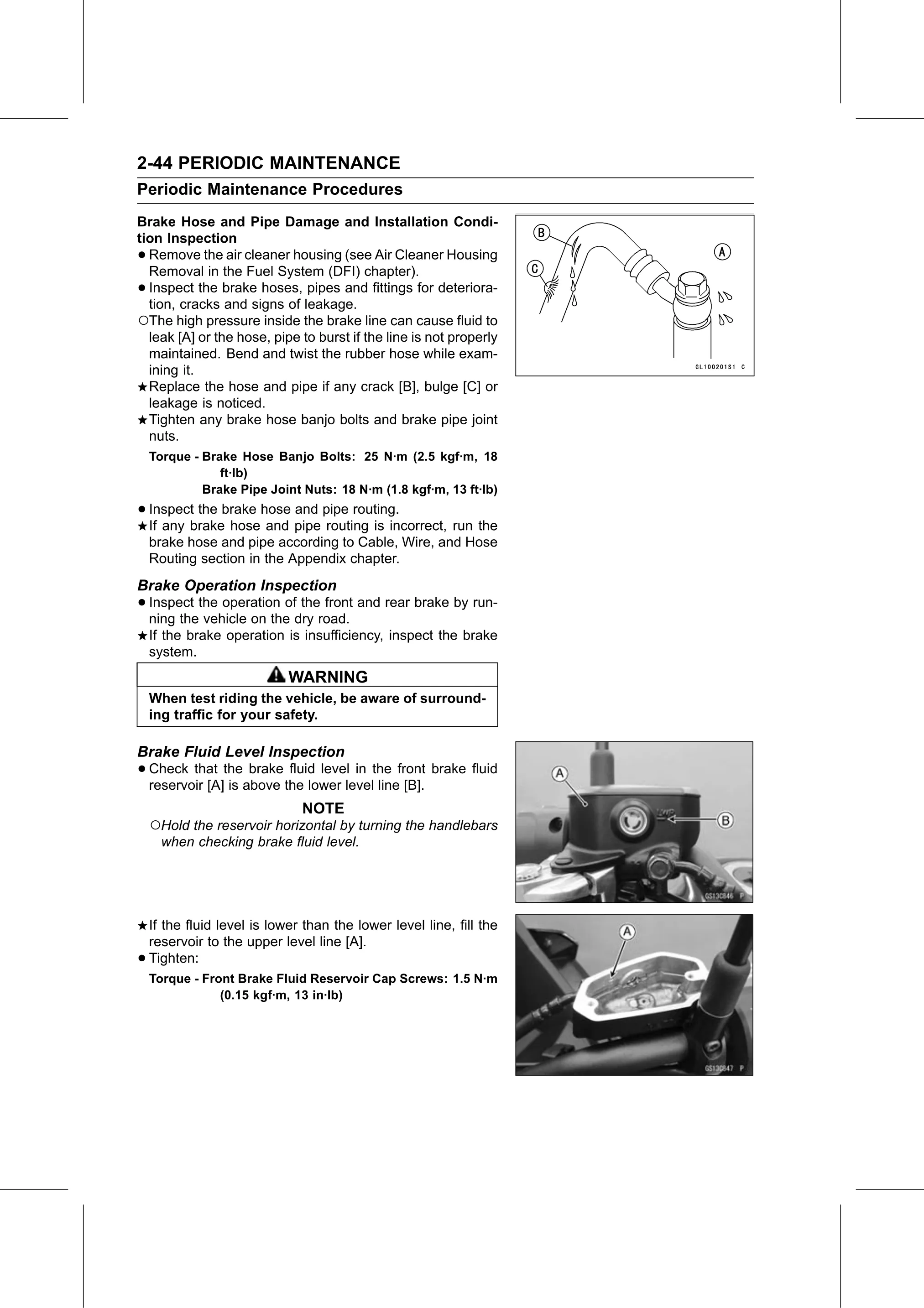
○The high pressure inside the brake line can cause fluid to
  leak [A] or the hose, pipe to burst if the line is not properly
  maintained. Bend and twist the rubber hose while exam-
  ining it.
  Replace the hose and pipe if any crack [B], bulge [C] or
  leakage is noticed.
  Tighten any brake hose banjo bolts and brake pipe joint
  nuts.
    Torque - Brake Hose Banjo Bolts: 25 N·m (2.5 kgf·m, 18
                ft·lb)
             Brake Pipe Joint Nuts: 18 N·m (1.8 kgf·m, 13 ft·lb)
• Inspect the brake hose and pipe routing.
  If any brake hose and pipe routing is incorrect, run the
    brake hose and pipe according to Cable, Wire, and Hose
    Routing section in the Appendix chapter.
Brake Operation Inspection
• Inspect the operation of the front and rear brake by run-
  ning the vehicle on the dry road.
    If the brake operation is insufficiency, inspect the brake
    system.
                             WARNING
    When test riding the vehicle, be aware of surround-
    ing traffic for your safety.

Brake Fluid Level Inspection
• Check  that the brake fluid level in the front brake fluid
  reservoir [A] is above the lower level line [B].
                               NOTE
    ○Hold the reservoir horizontal by turning the handlebars
      when checking brake fluid level.

    If the fluid level is lower than the lower level line, fill the
    reservoir to the upper level line [A].
•   Tighten:
    Torque - Front Brake Fluid Reservoir Cap Screws: 1.5 N·m
                (0.15 kgf·m, 13 in·lb)