Service Manual — page 115 of 715
Fuel System (DFI) › DFI Servicing Precautions
Text on this page
FUEL SYSTEM (DFI) 3-25
DFI Servicing Precautions
DFI Servicing Precautions
  There are a number of important precautions that should
be followed servicing the DFI system.

○This DFI system is designed to be used with a 12 V sealed
 battery as its power source. Do not use any other battery
 except for a 12 V sealed battery as a power source.
○Do not reverse the battery cable connections. This will
 damage the ECU.
○To prevent damage to the DFI parts, do not disconnect the
 battery cables or any other electrical connections when
 the ignition switch is on, or while the engine is running.
○Take care not to short the leads that are directly con-
 nected to the battery positive (+) terminal to the chassis
 ground.
○When charging, remove the battery from the motorcycle.
 This is to prevent ECU damage by excessive voltage.

○Whenever the DFI electrical connections are to be dis-
 connected, first turn off the ignition switch, and disconnect
 the battery (–) terminal. Do not pull the lead, only the con-
 nector. Conversely, make sure that all the DFI electrical
 connections are firmly reconnected before starting the en-
 gine.
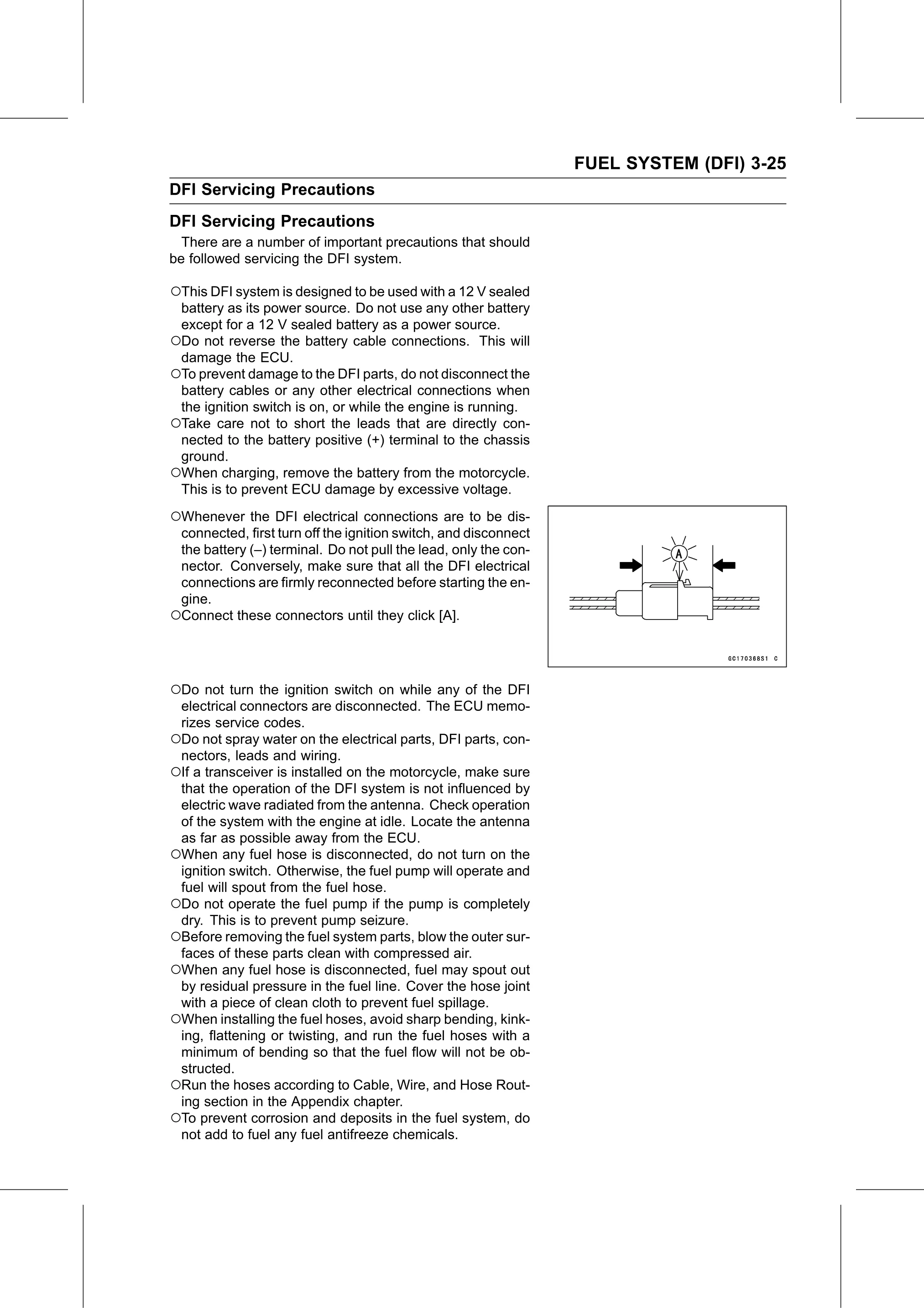
○Connect these connectors until they click [A].

○Do not turn the ignition switch on while any of the DFI
 electrical connectors are disconnected. The ECU memo-
 rizes service codes.
○Do not spray water on the electrical parts, DFI parts, con-
 nectors, leads and wiring.
○If a transceiver is installed on the motorcycle, make sure
 that the operation of the DFI system is not influenced by
 electric wave radiated from the antenna. Check operation
 of the system with the engine at idle. Locate the antenna
 as far as possible away from the ECU.
○When any fuel hose is disconnected, do not turn on the
 ignition switch. Otherwise, the fuel pump will operate and
 fuel will spout from the fuel hose.
○Do not operate the fuel pump if the pump is completely
 dry. This is to prevent pump seizure.
○Before removing the fuel system parts, blow the outer sur-
 faces of these parts clean with compressed air.
○When any fuel hose is disconnected, fuel may spout out
 by residual pressure in the fuel line. Cover the hose joint
 with a piece of clean cloth to prevent fuel spillage.
○When installing the fuel hoses, avoid sharp bending, kink-
 ing, flattening or twisting, and run the fuel hoses with a
 minimum of bending so that the fuel flow will not be ob-
 structed.
○Run the hoses according to Cable, Wire, and Hose Rout-
 ing section in the Appendix chapter.
○To prevent corrosion and deposits in the fuel system, do
 not add to fuel any fuel antifreeze chemicals.