Service Manual (KLZ1000C) — page 127 of 762
Fuel System (DFI) › Fuel Pressure Inspection
Text on this page
FUEL SYSTEM (DFI) 3-43
Fuel Line
Fuel Pressure Inspection
• Remove:
   Fuel Hose (see Fuel Hose Replacement(2-19))
○Be sure to place a piece of cloth around the fuel outlet
    pipe of the fuel pump and the delivery pipe of the throttle
    body assy.
                           WARNING
    Fuel is flammable and explosive under certain con-
    ditions and can cause severe burns. Be prepared
    for fuel spillage; any spilled fuel must be completely
    wiped up immediately. When the fuel hose is dis-
    connected, fuel spills out from the hose and the
    pipe because of residual pressure. Cover the hose
    connection with a piece of clean cloth to prevent
    fuel spillage.

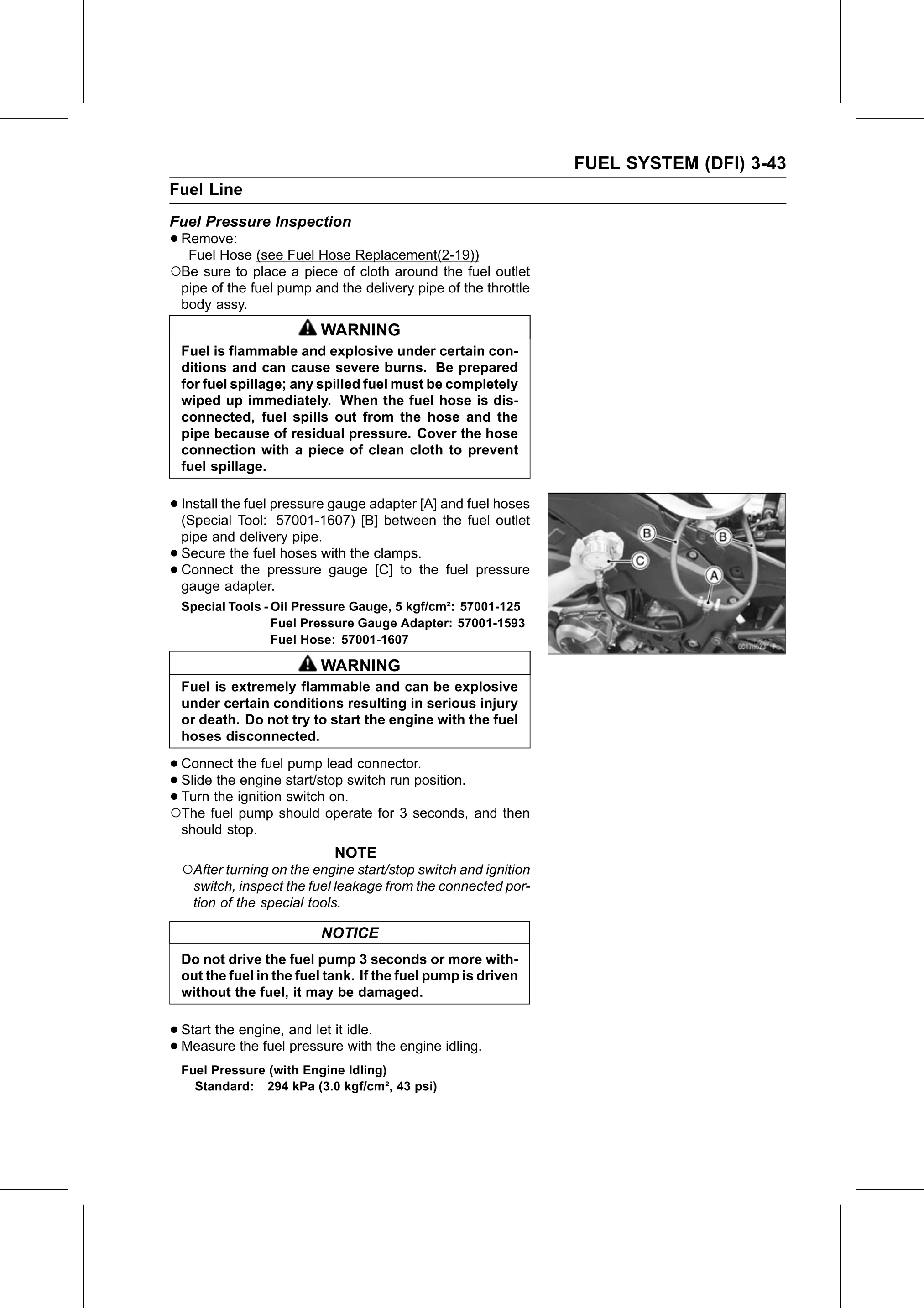
• Install the fuel pressure gauge adapter [A] and fuel hoses
  (Special Tool: 57001-1607) [B] between the fuel outlet
    pipe and delivery pipe.
•   Secure the fuel hoses with the clamps.
•   Connect the pressure gauge [C] to the fuel pressure
    gauge adapter.
    Special Tools - Oil Pressure Gauge, 5 kgf/cm²: 57001-125
                    Fuel Pressure Gauge Adapter: 57001-1593
                    Fuel Hose: 57001-1607

                           WARNING
    Fuel is extremely flammable and can be explosive
    under certain conditions resulting in serious injury
    or death. Do not try to start the engine with the fuel
    hoses disconnected.

• Connect   the fuel pump lead connector.
• Turn the ignition
  Slide the  engine start/stop switch run position.
•○The fuel pump should
                     switch on.
                           operate for 3 seconds, and then
    should stop.
                             NOTE
    ○After turning on the engine start/stop switch and ignition
      switch, inspect the fuel leakage from the connected por-
      tion of the special tools.

                           NOTICE
    Do not drive the fuel pump 3 seconds or more with-
    out the fuel in the fuel tank. If the fuel pump is driven
    without the fuel, it may be damaged.

• Start the engine, and let it idle.
• Measure   the fuel pressure with the engine idling.
    Fuel Pressure (with Engine Idling)
      Standard: 294 kPa (3.0 kgf/cm², 43 psi)