Service Manual (KLZ1000C) — page 366 of 762
Brakes › Brake Line Bleeding
Text on this page
12-26 BRAKES
Brake Fluid
Brake Fluid Level Inspection
• Refer to the Brake Fluid Level Inspection (see Brake Fluid
  Level Inspection(2-41)).
Brake Fluid Change
• Refer to the Brake Fluid Change (see Brake Fluid
  Change(2-42)).
Brake Line Bleeding
   The brake fluid has a very low compression coefficient so
that almost all the movement of the brake lever or pedal
is transmitted directly to the caliper for braking action. Air,
however, is easily compressed. When air enters the brake
lines, brake lever or pedal movement will be partially used
in compressing the air. This will make the lever or pedal feel
spongy, and there will be a loss in braking power.
                            WARNING
    Air in the brake lines diminish braking performance
    and can cause an accident resulting in injury or
    death. If the brake lever or pedal has a soft or
    “spongy” feeling mushy when it is applied, there
    might be air in the brake lines or the brake may be
    defective. Do not operate the vehicle and service
    the brake system immediately.

                              NOTE
    ○The procedure to bleed the front brake line is as follows.
     Bleeding the rear brake line is the same as for the front
     brake.

    Recommended Brake Fluid
      Grade:       DOT4

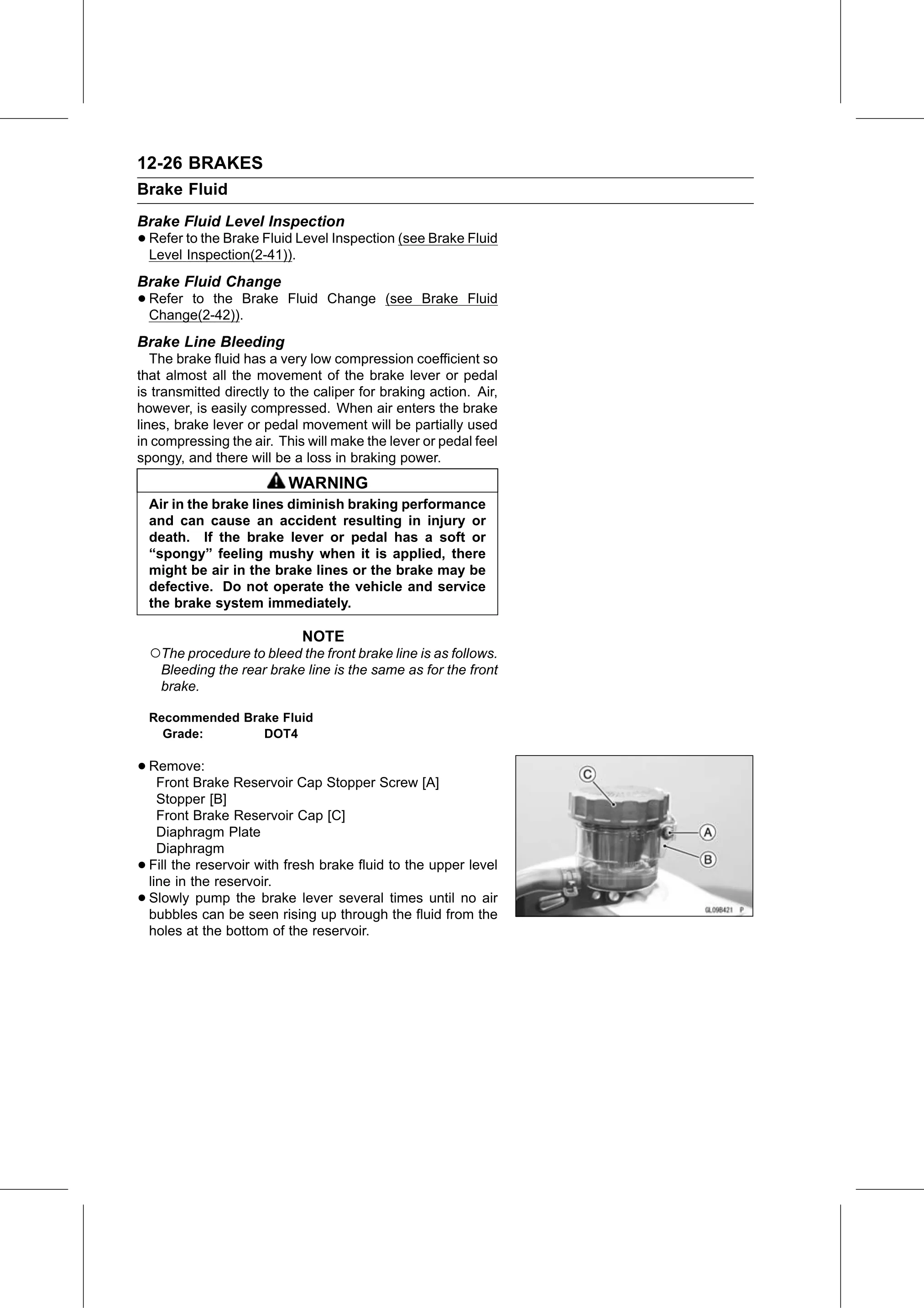
• Remove:
   Front Brake Reservoir Cap Stopper Screw [A]
      Stopper [B]
      Front Brake Reservoir Cap [C]
      Diaphragm Plate
      Diaphragm
•   Fill the reservoir with fresh brake fluid to the upper level
    line in the reservoir.
•   Slowly pump the brake lever several times until no air
    bubbles can be seen rising up through the fluid from the
    holes at the bottom of the reservoir.