Service Manual (KLZ1000C) — page 376 of 762
Brakes › ABS Servicing Precautions
Text on this page
12-36 BRAKES
Anti-Lock Brake System

                          WARNING
  Air in the brake lines diminish braking performance
  and can cause an accident resulting in injury or
  death. If any of the brake line fittings, including the
  ABS hydraulic unit joint nuts, or the bleed valve is
  opened at any time, the air must be bled completely
  from the brake line. If the brake lever has a soft or
  “spongy” feeling mushy when it is applied, there
  might be air in the brake lines or the brake may be
  defective. Do not operate the vehicle and service
  the brake system immediately.

                          NOTICE
  Do not ride the motorcycle with air in the brake line,
  or the ABS could malfunction.

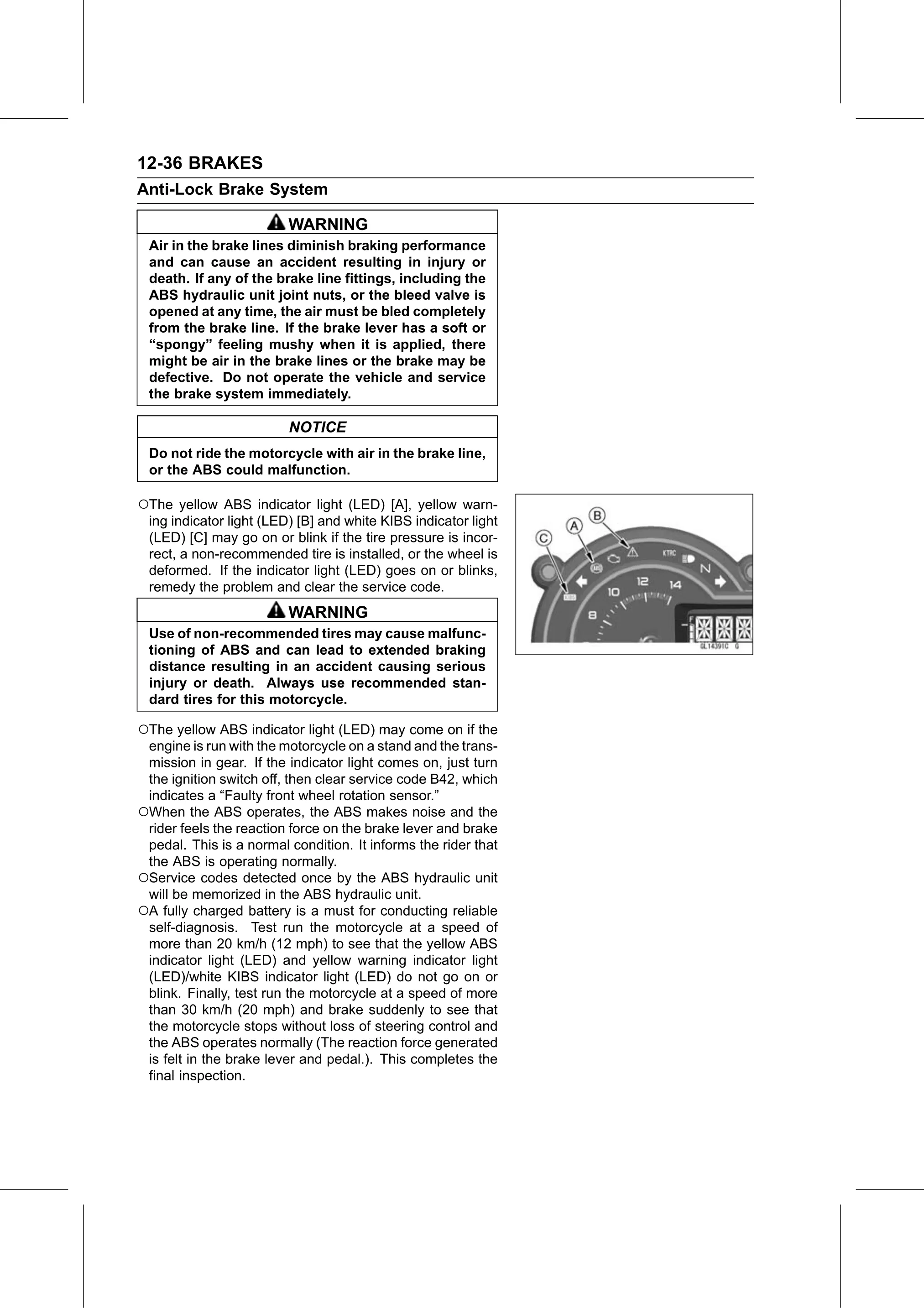
○The yellow ABS indicator light (LED) [A], yellow warn-
  ing indicator light (LED) [B] and white KIBS indicator light
  (LED) [C] may go on or blink if the tire pressure is incor-
  rect, a non-recommended tire is installed, or the wheel is
  deformed. If the indicator light (LED) goes on or blinks,
  remedy the problem and clear the service code.
                          WARNING
  Use of non-recommended tires may cause malfunc-
  tioning of ABS and can lead to extended braking
  distance resulting in an accident causing serious
  injury or death. Always use recommended stan-
  dard tires for this motorcycle.

○The yellow ABS indicator light (LED) may come on if the
 engine is run with the motorcycle on a stand and the trans-
 mission in gear. If the indicator light comes on, just turn
 the ignition switch off, then clear service code B42, which
 indicates a “Faulty front wheel rotation sensor.”
○When the ABS operates, the ABS makes noise and the
 rider feels the reaction force on the brake lever and brake
 pedal. This is a normal condition. It informs the rider that
 the ABS is operating normally.
○Service codes detected once by the ABS hydraulic unit
 will be memorized in the ABS hydraulic unit.
○A fully charged battery is a must for conducting reliable
 self-diagnosis. Test run the motorcycle at a speed of
 more than 20 km/h (12 mph) to see that the yellow ABS
 indicator light (LED) and yellow warning indicator light
 (LED)/white KIBS indicator light (LED) do not go on or
 blink. Finally, test run the motorcycle at a speed of more
 than 30 km/h (20 mph) and brake suddenly to see that
 the motorcycle stops without loss of steering control and
 the ABS operates normally (The reaction force generated
 is felt in the brake lever and pedal.). This completes the
 final inspection.