Service Manual (KLZ1000C) — page 377 of 762
Brakes › ABS Troubleshooting Outline
Text on this page
BRAKES 12-37
Anti-Lock Brake System
ABS Troubleshooting Outline
  When an abnormality in the system occurs, the yellow
ABS indicator light (LED) goes on and/or yellow warning
indicator light (LED) goes on and white KIBS indicator light
(LED) blinks to alert the rider. In addition, the nature of the
fault is stored in the memory of the ABS hydraulic unit and
FI ECU, and when in the self-diagnosis mode, the service
code is displayed on the LCD by the “B” and the number of
two digits. When repair has been done, the indicator lights
(LED) go off and service codes are not displayed. But the
service codes stored in memory of the ABS hydraulic unit
ECU and FI ECU are not erased to preserve the problem
history.
  When, due to a malfunction, the yellow ABS indicator light
(LED), yellow warning indicator light (LED) and white KIBS
indicator light (LED) remain lit or blink, get a thorough un-
derstanding of the background before starting the repair
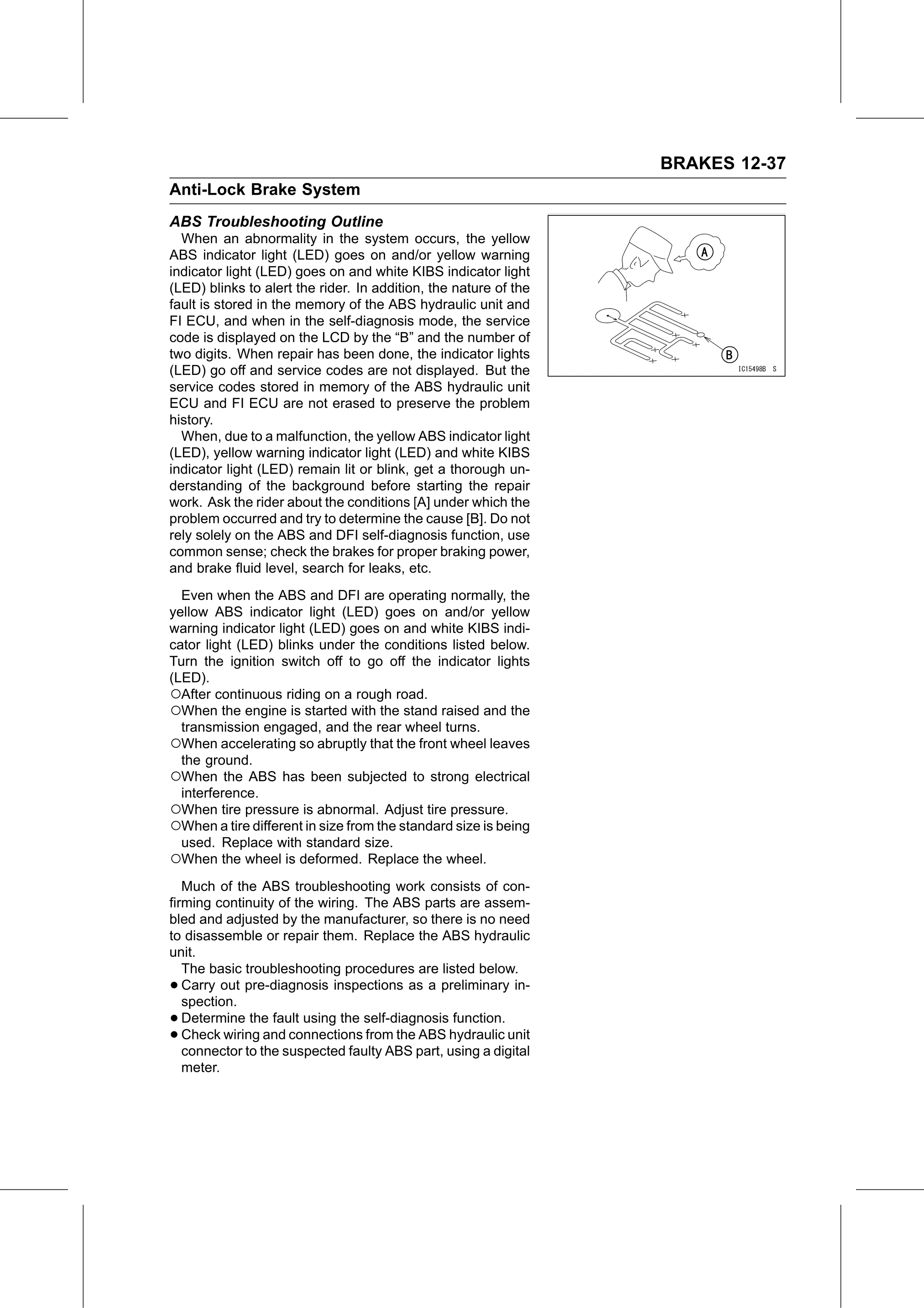
work. Ask the rider about the conditions [A] under which the
problem occurred and try to determine the cause [B]. Do not
rely solely on the ABS and DFI self-diagnosis function, use
common sense; check the brakes for proper braking power,
and brake fluid level, search for leaks, etc.
  Even when the ABS and DFI are operating normally, the
yellow ABS indicator light (LED) goes on and/or yellow
warning indicator light (LED) goes on and white KIBS indi-
cator light (LED) blinks under the conditions listed below.
Turn the ignition switch off to go off the indicator lights
(LED).
○After continuous riding on a rough road.
○When the engine is started with the stand raised and the
  transmission engaged, and the rear wheel turns.
○When accelerating so abruptly that the front wheel leaves
  the ground.
○When the ABS has been subjected to strong electrical
  interference.
○When tire pressure is abnormal. Adjust tire pressure.
○When a tire different in size from the standard size is being
  used. Replace with standard size.
○When the wheel is deformed. Replace the wheel.
   Much of the ABS troubleshooting work consists of con-
firming continuity of the wiring. The ABS parts are assem-
bled and adjusted by the manufacturer, so there is no need
to disassemble or repair them. Replace the ABS hydraulic
unit.
   The basic troubleshooting procedures are listed below.
•  Carry out pre-diagnosis inspections as a preliminary in-
   spection.
•  Determine the fault using the self-diagnosis function.
•  Check wiring and connections from the ABS hydraulic unit
   connector to the suspected faulty ABS part, using a digital
   meter.