Service Manual — page 120 of 715
Fuel System (DFI) › Outline
Text on this page
3-30 FUEL SYSTEM (DFI)
Troubleshooting the DFI System
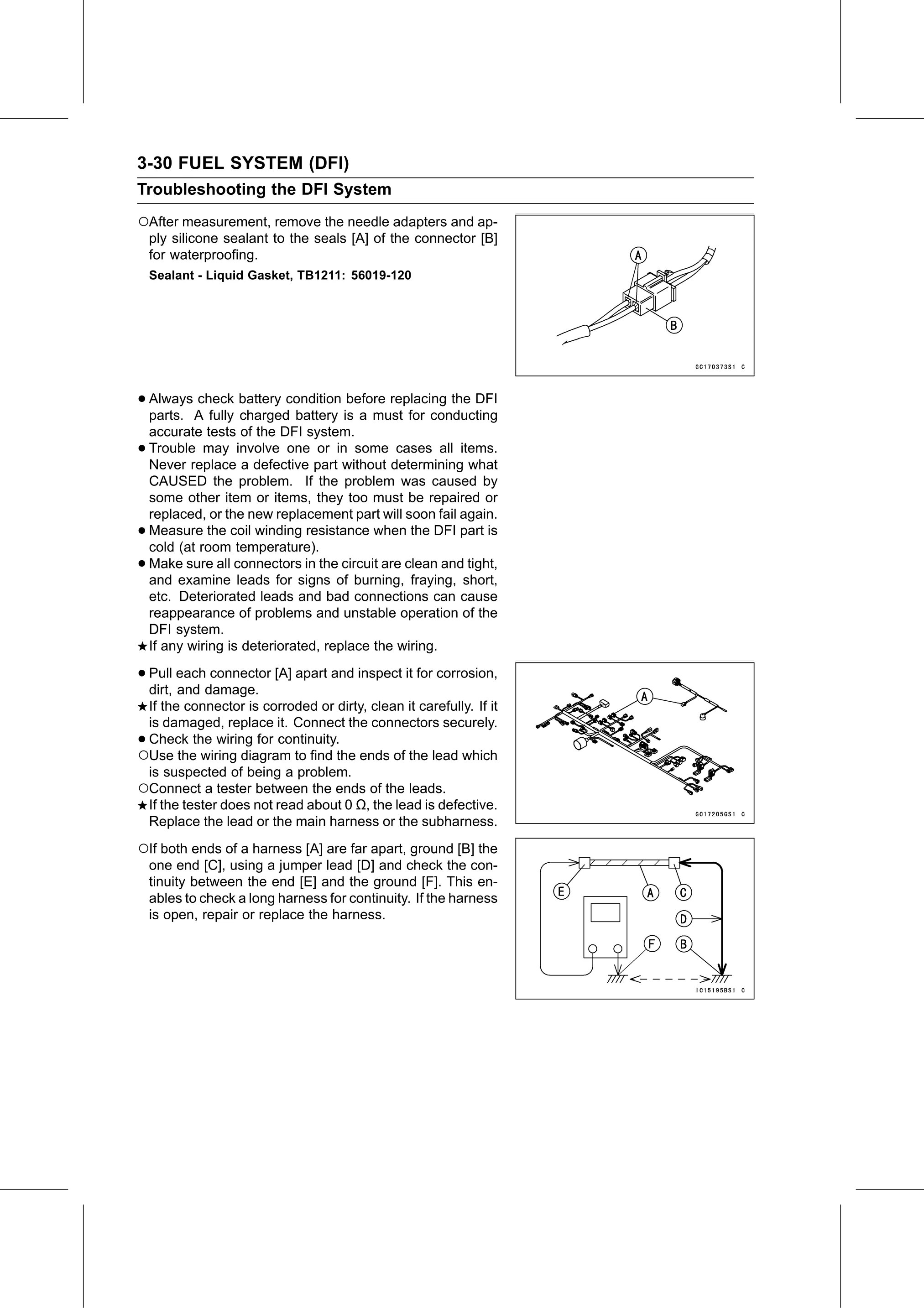
○After measurement, remove the needle adapters and ap-
    ply silicone sealant to the seals [A] of the connector [B]
    for waterproofing.
    Sealant - Liquid Gasket, TB1211: 56019-120

• Always check battery condition before replacing the DFI
  parts. A fully charged battery is a must for conducting
    accurate tests of the DFI system.
•   Trouble may involve one or in some cases all items.
    Never replace a defective part without determining what
    CAUSED the problem. If the problem was caused by
    some other item or items, they too must be repaired or
    replaced, or the new replacement part will soon fail again.
•   Measure the coil winding resistance when the DFI part is
    cold (at room temperature).
•   Make sure all connectors in the circuit are clean and tight,
    and examine leads for signs of burning, fraying, short,
    etc. Deteriorated leads and bad connections can cause
    reappearance of problems and unstable operation of the
    DFI system.
    If any wiring is deteriorated, replace the wiring.

• Pull  each connector [A] apart and inspect it for corrosion,
  dirt, and damage.
 If the connector is corroded or dirty, clean it carefully. If it
 is damaged, replace it. Connect the connectors securely.
•Check the wiring for continuity.
○Use the wiring diagram to find the ends of the lead which
 is suspected of being a problem.
○Connect a tester between the ends of the leads.
 If the tester does not read about 0 Ω, the lead is defective.
 Replace the lead or the main harness or the subharness.

○If both ends of a harness [A] are far apart, ground [B] the
    one end [C], using a jumper lead [D] and check the con-
    tinuity between the end [E] and the ground [F]. This en-
    ables to check a long harness for continuity. If the harness
    is open, repair or replace the harness.